6 min read
- A24’s The Drama is the film company’s most anticipated film of the year. Starring Robert Pattinson and Zendaya, the plot follows a soon-to-be married couple on the brink of a break-up.
- The film takes part largely in the fictional couple’s shared apartment. The plot unfolds through thoughtful lighting and a gently evolving set design.
- Zosia Mackenzie, the film’s production designer, gave House Beautiful an exclusive take on how she approached creating the set’s “lived-in” aesthetic.
For A24’s most anticipated film of the year, production designer Zosia Mackenzie isn’t taking us to foreign lands or navigating a period plot. She’s bringing us to Boston’s Financial District and into a shockingly normal apartment.
A24’s The Drama follows a relationship on the brink of ruin as Charlie Thompson, played by Robert Pattinson, and Emma, portrayed by Zendaya, grapple with a long-hidden secret that, when exposed, threatens to end their relationship. Staged primarily in Charlie and Emma’s shared Boston apartment, the couple attempts to navigate the breakdown of their relationship just days before their vows, as an evening of taste testing plummets the pair’s engagement into a complex web of emotions ranging from guilt and regret to disgust. The plot is captured through more than just dramatic dialogue. It’s told primarily through lighting, artwork, and Zosia Mackenzie’s character-driven, mid-century modern set design.
Mackenzie, who also designed the set for Nicholas Cage’s Dream Scenario and Alexander Skarsgård’s Infinity Pool, worked to capture an almost underwhelming normalcy in the set of The Drama. The designer tapped into thrifted furniture, a lived-in aesthetic, and carefully placed details to bring an air of the ordinary to the set.

“We really put ourselves in their shoes,” Mackenzie says. “We all left our homes, mine in Toronto, director Kristoffer (Borgli) in L.A., and photography director Arseni (Khachaturan) in New York. We packed our bags and essentially moved to Boston, and, as much as possible, tried to really get to know all the stores there, the galleries. We went to all the bookshops and just sort of acted, put ourselves in their shoes. We were really feeling the local vibe.”
Bostonians will notice the city’s touch in the set, as a majority of the smaller, detailed pieces were thrifted in The Hub, including the “thousands” of books that line the apartment’s expansive bookshelves, perhaps the only nod to Emma’s character and her love for literature, channeled in the plot through her job as a literary editor. Sourced from the Catherine Small Gallery on Somerville’s Beacon Street, each title was carefully selected to represent the fictional couple’s unique interests, an ode to Mackenzie’s commitment to thoughtful design.
Another favorite haunt was the Cambridge Antique Market, where Mackenzie and her partner, art director John Regan, spent weekends searching booths for the perfect décor to complement the plot. The couple also took trips to Maine and New York to find pieces like the contemplative dining table, sourced from vintage furniture curators at New York’s Abbi and Marie. Even larger pieces, like the vibrant 70s’ blue tweed Knoll sofa, were sourced locally, with the living room’s centerpiece coming from Cambridge’s own curated showroom at Reside Inc.

“I think sofas are always really hard. We looked at a lot of different options, and then finally we saw that one. We were like, ‘This is it.’ It's just a very classic piece. Sometimes it's kind of nice to ground a space with a more classic piece like that,” Mackenzie explains.
Flanked by the Charles Pollock 657 chairs, the set’s design, much like the plot’s tension, hinges largely on Charlie’s character, playing heavily on his interests and dedication to the art world.
“Charlie is quite ingrained in the local scene, so we wanted it to be both, of course, accurate to the characters and who they are, but also natural, not too perfect,” Mackenzie says. “The artwork was a huge one that we did a deep dive into some local artists in Boston that would make sense that he'd be interested in, and starting to collect.”
Artwork became essential to the set’s design, with Mackenzie and the team dedicating a considerable effort to curating originals and accurately recreating pieces, a huge undertaking for even the most experienced of art teams.


“We worked with a lot of galleries in New York, like Perrotin and Kordansky, and were able to get some high-res images from a lot of those artists. We worked with our graphics team and printed them all on linen, canvas, or paper—whatever substrate the artwork was originally made on. Then, we worked with our construction team to frame everything. So essentially, we did everything in-house, but in collaboration with the artists, so everything was true to how it was intended. But art, that was a really big one.”
The film’s small apartment is covered in art, with Sara Cynwar’s Peony II making an appearance, as well as Bjarne Bare’s Shell. But Tristan Unrau’s colorful and slightly sickening Shambolic Figure, poised prominently above the mantel, takes center stage in the set’s design.

“We were lucky we got to spend some time in the apartment together before filming. That was sort of the reason behind the placement and the piece itself. In a way, it's almost like a little bit of a reflection of Charlie,” Mackenzie says. “Tristan Unrau, that was one of those very fortuitous situations where he and Kristoffer are actually friends. They met in L.A., but Tristan is originally from Canada, as am I. So, that was a nice little background story as well. It’s nice when you have links like that.”
The plot’s ties to the art world transcend the apartment. A portion of the movie was filmed at the Addison Gallery of American Art in Andover, Massachusetts. The setting allowed for Washington Allston’s Italian Landscape and George Inness’s The Coming Storm to make appearances in the film.
But painting wasn’t a job left to the greats; Mackenzie’s vision for the near “perfect” apartment included a sage kitchen, which needed to be painted for the set. The team selected Benjamin Moore’s grey-green Norway Spruce to bring color to the otherwise white-walled space.
“It’s a smallish kitchen, and the cabinets were already cream, so the green just felt complementary to it,” says Mackenzie. “From the get-go, it was like, okay, we're going to paint it this color. And of course, we looked at some different shades on the camera test. I think you just have those reactions or instincts, and that was our gut instinct from when we just stepped into the space, so we stuck to it.”
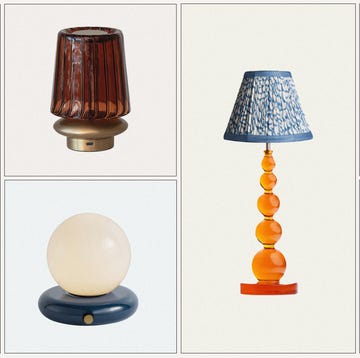
Even in the face of striking artwork, Mackenzie’s favorite detail from the set is a tie between the $1800 Flo’s orange Snoopy table lamp and the Marset dipping lamp, designed especially for the film. Lighting plays a crucial role in director and writer Kristoffer Borgli’s storytelling, so it makes sense that some of Mackenzie’s favorite details are found in lighting fixtures.

“I was staying in New York, and I went with my mom and my partner to a restaurant, I think it's called Shukette, and they had these (Marset) lamps there. I remember being like, ‘Wow, these are so incredible. They're lighting the space so beautifully, just their glow. They’re a very special piece.’ A few days later, I walked past the Marset store, and it was right there in the window. So I stepped in and got to talking with a person in the store—I was just like, ‘Wow, these lamps are so beautiful. I would love an excuse to put one in a movie.’ And then, probably a few months later, Chris calls with this film, and it just stuck in my mind.”
The team had just three weeks to build, paint, and style the apartment set. This came after ten weeks of prep work and location scouting. The design team did such a good job bringing Mackenzie’s vision of the couple’s home to life that stars Robert Pattinson and Zendaya spent time barefoot and lounging on the set, picking up titles from the styled shelves and curling up on the vintage furniture. Like the curation process, the placement of each piece and prop was intentional, meant to channel that ever-elusive lived-in flair. To achieve the enviable, yet everyday aesthetic, Mackenzie says you must leave room for a bit of error and a lot of evolution.

“We played a little bit with the asymmetry, in terms of the lamps in the living room and also in the bedroom. Just so things are maybe just slightly askew,” Mackenzie explains. “There are a few time jumps and cuts back and forth, where it's quite subtle, but we would switch out a piece of artwork in the bedroom, or we would switch a lamp or the bedding. Very subtle things to show the time change because so much of it (the plot) is told through them and their stories, and of course, the writing of the vows. So there are, again, some subtle changes that we did with some of the dressing. Definitely with the artwork, because someone who's working as a curator, I think it would make sense. Pieces would kind of come and go.”