4 min read
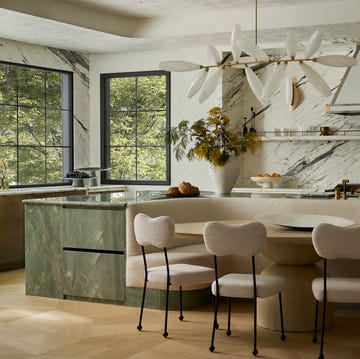
The above kitchen was designed by Eddie Maestri and displays multiple types of lighting, including a stunning skylight.
The kitchen is often seen as a functionality-first space. While we at House Beautiful argue that even the most utilitarian spaces can benefit from aesthetic enhancements, one practical feature you cannot overlook is lighting. After all, working in a dark kitchen could be a recipe for disaster.
“Every kitchen needs three essential layers of lighting: ambient, task, and accent. But I always like to sneak in decorative lighting as the personality layer,” says designer Linda Hayslett of LH.Designs.
This kitchen lighting formula ensures that, as you slice and dice, you can see well enough to avoid ending up in the ER after nicking a finger, and you can also appreciate the space you’re in. Your kitchen lighting can even help section out certain zones, such as a coffee corner or serving station.
Lighting creates depth; it needs to be layered. “Without proper lighting, even the most beautifully designed kitchen can fall flat,” Hayslett says. Allow your hardware to sparkle, let your stone glow, make your cabinetry feel rich. “Lighting isn’t an afterthought; it’s the polish. It’s the jewelry. It’s what pulls the whole look together.”
Below, we break down the different types of lighting your kitchen needs to really shine, as well as the best light temperature for this space. Keep reading for insider information to truly make your kitchen one of your dreams.
Best Light Temperature for the Kitchen
Before getting into the specific types of lighting and light fixtures, you need to understand some rules of thumb about light temperature in your kitchen.
One of the most important things to note? Always use light bulbs with the same temperature. For instance, don’t have a 2700 Kelvin (K) bulb above your sink, then a 3500K bulb by your stove—this can completely change the vibe of your space and make your colors feel off. Especially in a dark or deeper-toned kitchen, the wrong lighting temperature can make everything feel dull.
In residential cook spaces, Hayslett likes to stay within the 2700K and 3000K range. A 2700K light bulb emits a warm white glow, though it leans more yellow, making it feel more inviting and even flattering. A 3000K light bulb is a touch whiter but still soft. “Anything above 3500K in a home kitchen starts to feel commercial. Once you hit 4000K, it’s giving hospital break room,” she adds.
Ambient Lighting

The overall glow of your space is called ambient lighting. It comes from multiple directions to evenly illuminate a room rather than lighting a concentrated spot. This type of lighting ensures you aren’t “cooking in a cave,” as Hayslett puts it.
Best Light Fixtures for Ambient Lighting
Hayslett explains that thoughtfully spaced recessed LED lights are one of the most reliable ways to evenly light a kitchen.
“The layout should be planned carefully so the light distributes evenly across the room and, most importantly, across the countertops, not just down the center of the ceiling,” she says. If recessed lighting isn’t possible for whatever reason, a well-scaled flush mount is the next best option. It just has to diffuse light evenly and shouldn’t feel harsh.
One of Hayslett’s best tips when designing the ambient lighting in a kitchen is being able to choose the light temperature at installation in order to tailor the tone of light to the cabinetry, countertops, and general mood of the space.


Task Lighting

Task lighting is how you can actually see what you’re doing in the kitchen.
“Under-cabinet lighting for chopping, pendants over the island, and lighting over the sink help target the areas where you need to concentrate, because no one wants to dice onions in their own shadow,” Hayslett says. It’s direct, focused, and extremely essential in this space.
Best Light Fixtures for Task Lighting
Hayslett likes using “concealed LED under-cabinet strips with no visible light dots” and pendants over the kitchen island for her task lighting layer. Of course, you must keep proportions in mind when picking out pendant lights, as too large ones can look overpowering and too small ones can feel awkward. There’s also the option of directional lighting above the sink if needed.
Accent Lighting

Accent lighting is where it gets a bit more fun—this is where you “highlight the good stuff,” as Hayslett puts it. Use this layer to enhance architectural details, open shelving cabinetry, and other statement features, like a backsplash. “They help show the elements you invested in and actually want people to notice.” Accent lighting is more concentrated on one subject, though with the other layers, it doesn’t look harsh.
Best Light Fixtures for Accent Lighting
Picture lights, like the one in the photo above, are elegant options for accent lighting and can make the specific design moment you’re highlighting feel more elevated. Hayslett likes interior cabinet lighting for glass-fronts and toe-kick lighting for a subtle nighttime glow. Whether you have a walk-in pantry or a closet, adding lighting in that space, too, can help you feel more organized.
Decorative Lighting

This is the lighting layer that truly lets your personality shine through. Though decorative lighting isn’t essential, Hayslett doesn’t think it should be skipped.
“Sculptural pendants or a statement chandelier that says, ‘Yes, this kitchen has a point of view.’ It adds personality and often becomes the focal moment of the space.”
Best Light Fixtures for Decorative Lighting
Any type of additional lighting after the three main layers can be counted as decorative. However, your decorative lighting can double as other types, such as task lighting. The photo above of one of Hayslett’s projects beautifully demonstrates this: the striking pendant lights above the island are technically task lighting (since the opaque shade focuses light downward instead of diffusing it through the room), but because they’re so intriguing and eye-catching, they’re also decorative.