6 min read
When designing your home, there’s plenty to take into account: budget, personal taste, and even physical accessibility. But what about mental safety? It’s often an afterthought when the contractor visits are over, and we suddenly realize something is stressing us out about our space. Cue that antsy feeling sitting at home. It’s even more intense for neurodivergent brains.
Whether you’re designing for the novelty-seeking ADHD brain or the highly sensitive brains of those on the autism spectrum, there are special design needs to keep in mind. But by following a few main principles, your environment can serve as a tool for regulating your nervous system.
We consulted experts in design psychology and neurodivergence to identify these principles and get some sound advice. Dr. Rachel Melvald, licensed psychotherapist and founder of Psychitecture, regularly advises clients on designing for brain-friendly rooms. Clare Kumar, founder of Happy Space, is autistic and has ADHD herself, and she views creating fulfilling lives through an interior that grounds you. Kumar has identified three main elements you should have for neurological safety in your home.
“If you don't have all three, you're asking people to give you their energy to get through,” Kumar says. “Give me some of your self-regulatory skills, and let's hope you're not depleted before the end, because that's when autistic shutdown will happen, or meltdown will happen.”
Read on for everything you need to keep in mind when creating an environment built for your nervous system.
Sensory Support
This first element is grounded in the stimuli of your home. Think the five senses: what are the scents, sights, textures, and noises that make up your space? Kumar defines it as “knowing that we have either the environment that supports our nervous system, or we have the ability to adjust it.” This could look like angling the fan in a different direction, dimming the light, turning off a scent diffuser, or changing the color temperature with smart light bulbs.
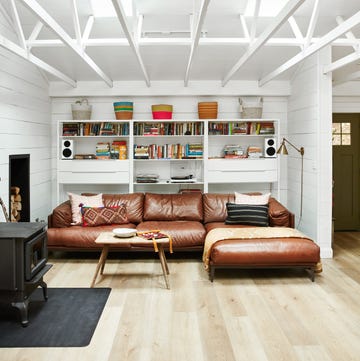
Softness in texture is always welcome, like adding soft rugs that reduce echo and noise. “A lot of texture that reduces sharpness and pointiness can feel physically comforting,” Melvald says. “In our brain, it signals, ‘This is safe to land.’” But what could be soothing to one could be incredibly vexing and irritating to another. So if every bit of seating in your home is velvet, but a guest can’t stand the texture, a throw blanket for them to sit on is an easy swap.

Keeping colors low-contrast can also avoid that jarring feeling. Melvald often looks to grounding, dusty tones when working in trauma-informed design. “Grounding is really what kind of gets us out of the overactive trauma brain,” Melvald says. “So when we're looking at our primitive brain going on ‘fight or flight,’ the more grounding colors could be beneficial for mental health.”
A good rule of thumb: The larger the surface, the lower the contrast should be from the rest of the room. Intentional moments in the room are where you should add richer color: think a cool vase or lamp as a pop of color, like flowers blooming in a field. “You wouldn't want a more highly saturated color to overwhelm the room,” Melvald says. “Too much contrast can be too jarring to the brain, and too little is going to be not orienting enough.”
Don’t forget about the lighting, either. You might already know that warmer color temperatures in your light bulbs can feel calmer. But investigate the quality of the LED bulbs in your home. We’re not that different from plants: we benefit from full-spectrum light often found in grow lights. Kumar says that “high-quality LED lighting includes red spectrum wavelengths to support mitochondrial performance.” Translation: it’s literally healthier for our brain cells.
“You can actually have a warmer temperature that may not be good quality, and it may just be covered in phosphorus,” Kumar says. “It may just be giving you the illusion, but it’s sabotaging those mitochondria.”

Cognitive Kindness
You know you’re in a home that’s kind to your brain when you sigh with relief, just walking through the door. Kumar defines cognitive kindness as “being able to move forward with intuition.” Neurodivergent brains do a lot of mental wrestling. Kumar herself, living with autism and ADHD, is constantly navigating a need for structure and novelty simultaneously.


To strike that balance, you need single-use spaces with adaptability built in. Let’s break that down. Open-concept living can add a lot of cognitive load on the brain as it tries to figure out the purpose of each space. To reduce decision paralysis, have single-purpose spaces, well-defined so you know what to expect walking in. Where the novelty is found is in adaptable furniture and decor. A standing desk or modular couch can adjust with you as your needs change, so you don’t feel so stuck.

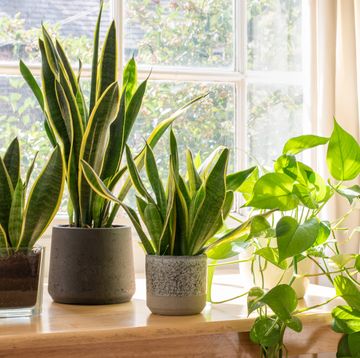
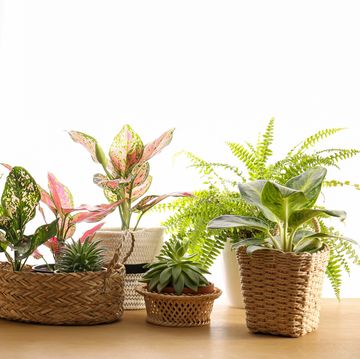
Another way to make your space feel cognitively kind? Follow the fractals. Our brains tend to want nature, and so we seek out fractals: the patterns that exist in nature. Ripples in a stream, the veins of a plant’s leaf, even a flickering flame. We’re naturally attracted to those repeating visuals, and any reminders of nature help ease our minds to a safer place. One of Melvald’s favorite pieces to style with is a fiddle-leaf fig, because of its minimal fractal patterns and soothing, deep green hue. Lean into that instead of cold steel or metal. “It's not natural to see exposed,” Kumar says. “It lives within the ground.”
But beware the pitfalls of patterned flooring. It can be tempting to have an embossed rug, with sunken-in portions that create a pleasing pattern. But it can be difficult to root yourself when the ground is literally shifting underneath you.

Emotional Engagement and Refuge
Safety is on Maslow’s Hierarchy of Needs for a reason. Your home needs to feel like a safe space for you, and this is even more important for a neurodivergent person. Take designing a playroom for a neurodivergent child.
“How can this playroom be organized in such a way that it can contain a lot of the sensory stimulation objects, but also put them away so as not be overstimulated?” Melvald asks. You need to have organization and safety features, whether it’s a handrail to hold onto or shelving for the toys. The furniture should be fun and colorful, yes, but also configured with enough space and light enough to reposition when needed. Lighting can be task-oriented, but it should also be layered.

Your home’s design should also be individualized, retaining a sense of belonging and emotional engagement with your space. You need to see yourself reflected in your environment; otherwise, you start to have a creeping sense of being an impostor, which doesn’t allow you to regulate.
“When we look at spaces of refuge, our brain naturally wants to orient in such a way that we can connect with people, objets d’art, or furniture,” Melvald says. Having cultural objects, pictures, or connections to your past in your home are all rooted reminders of who you are. Your memories are a cue to your brain, showing you who you are and cutting through the chaos and overstimulation. It makes you feel connected to—and dignifies—your space.
Creating neurological safety in your home is something that benefits every brain, no matter your neurodivergent status. Kumar sees how many neurodivergent people are “designed out” of spaces and have to adjust to environments that were never built for them. She sees the potential in “safer containers.” It sets humans up to see through their full potential, letting students complete their degree, and letting moms get their kids through breakfast and out the door.
“To be fulfilled, we have to receive, but before we can receive, we have to be able to give,” Kumar says. “What we're doing by designing people out is we're shutting off their ability to give. That is a crime. We're squandering human potential.”