12 min read
For House Beautiful’s 130th anniversary this year, we're digging into some of our favorite articles from our archive —from celebrity home tours (including Farrah Fawcett , Bette Midler, and more) to decades-old design inspiration that still holds up today. Stay tuned for more archive deep dives throughout 2026, and sign up for our newsletter to get the very best delivered to your inbox every month.
It was late summer of 1994, around the time John F. Kennedy first started seeing a high-profile publicist named Carolyn Bessette, but House Beautiful editor-in-chief Louis Oliver Gropp had a different Kennedy on his mind: Jackie. The former First Lady passed away on May 19th of that year, and it felt like the whole country was in mourning. Gropp wrote in his editor's letter for the September issue, entitled "American Nobility," about meeting Jackie a few years prior (she wanted him to run a particular story, which he did) and then published a whole feature in the same issue, entitled "Jackie, Queen of the Arts," about her influence on the design of the times. Read Gropp's editor's letter and the full feature by Martin Fuller below.
American Nobility
By Louis Oliver Gropp
When I was in Washington, D.C., shortly after the death of Jacqueline Kennedy Onassis, I took an hour to go to Arlington National Cemetery. I had to pay my respects to the woman we honor in another way in this issue, with our story on her great influence on American taste, style, and culture. As I stood in the line of people passing before her grave, and the adjacent graves of her two infants and her husband, President John F. Kennedy, I thought about her life and the many ways in which it crossed all of ours.
For example, in Martin Filler's tribute, he tells how she pursued the objects she felt should be returned to the nation's most historic rooms. "When Mrs. Kennedy asked for things she wanted for the White House," James Roe Ketchum, curator of the White House during the Kennedy administration, says with a laugh, "she did it in such a way that people never realized what hit them. It was such a soft sell, you just couldn't say no." I remember the soft sell. I experienced it myself over lunch with Jacqueline Kennedy Onassis at the Four Seasons restaurant a few years ago, when she was anxious that a story about friends of hers move out of our inventory and into our magazine. I assure you that, shortly after the lunch, it did.
But it was for others that she did the asking: whether in saving a historic landmark like Grand Central Station, promoting the work of young African-American textile designers in Brooklyn, or getting something published that she believed in. Jacqueline Kennedy made a clear distinction between her public and her private lives that showed in the way she used two very different interior designers at the White House: one for the upstairs family quarters, another for the main floor State Rooms. It also showed in the way she raised two fine children, ignored gossip, and conducted her private life once her public life was over.
Writing in Vanity Fair magazine, Dominick Dunne described how, after the death of her husband, Jacqueline Kennedy's grace and dignity calmed the nation. "Sadly, that nobility of behavior has subsequently slipped out of our lives," he wrote. But not if we learned what she had to teach us, for nobility of behavior is open to all of us.
Jackie, Queen of the Arts
By Martin Filler
"If good taste were the qualification for leadership," wrote Lance Morrow in a Time magazine essay in May following the death of Jacqueline Kennedy Onassis, "the greatest Presidents might be interior decorators." John Fitzgerald Kennedy didn't need to bother, for he was married to one of the most accomplished and influential decorative arts experts of our time. In fact, the effect that his wife had on American culture is incalculable.

Superbly self-educated for the role history presented her, Jacqueline Bouvier Kennedy understood that to be a good teacher, one must first be a good student. She called me just prior to the inauguration," remembers Leroy Davis, a New York art dealer who served on Mrs. Kennedy's Fine Arts Committee for the White House. "She had heard about a Maurice Prendergast show at the Museum of Fine Arts in Boston, and though she didn't know much about him, she was intrigued. So I talked to her for quite a while and encouraged her to see the work. And when the show went to the Whitney in New York, I took her to see it."
Several months later, in 1961, during the Kennedys' triumphant state visit to Paris, their gift to President Charles de Gaulle was a Prendergast watercolor of a Paris scene, Boulevard des Capucins. It seemed to be a subtle way of saying that the art of America was equal to that of France.
Of course, Jacqueline Kennedy's greatest artistic contribution was her restoration of the White House. She took the Executive Mansion from a drab, hotel-like institution ("Early Statler," as she mordantly put it), virtually devoid of historical furnishings and paintings other than presidential portraits, and transformed it into one of the foremost collections of American decorative and fine arts. Although she made the White House into a museum, it was also very much a home—welcoming, unpretentious, and livable.
Always acutely aware of the split between her public persona and her private self, Mrs. Kennedy used two very different interior designers at the White House. The upstairs family quarters were done by Sister Parish in the cozy, relaxed, well-bred manner that evoked Jacqueline Bouvier's upper-crust upbringing. The warm, understated yellow Oval Room, where the Kennedys gathered with guests for drinks before dinner, was the pinnacle of Mrs. Parish's career and an exemplar of American decoration at its best.
The main floor State Rooms were done by Stephane Boudin, legendary master of the House of Jansen, the venerable Paris decorating firm that had restored the palace of Versailles and numbered among its clients the Duke and Duchess of Windsor. Renowned for his knowledge of historical styles, faultless sense of proportion, and genius for furniture placement, Boudin gave the major reception rooms of the White House a dignity and grandeur lightened with an innately American simplicity. His Blue Room, though criticized by some for being "too French," reflected the spirit of President James Monroe's original 1817 furniture by Pierre-Antoine Bellange of Paris.
As seriously as she took her restoration project, Jackie wasn't above having a bit of fun at her French decorator's expense. "I had worked up a pretty good impersonation of Monsieur Boudin," reveals James Roe Ketchum, curator of the White House during the Kennedy Administration, "and we had an associate in our office who looked a bit like Mrs. Kennedy. Mrs. Kennedy would insist that for small parties, we do a kind of Nichols and May routine of redecorating a room. She didn't mind being mocked. She seemed to be able to bring out the child in every one of us. You saw the wit every day."

Otherwise, Jacqueline Kennedy went about her research with the dedication of a scholar and the diligence of a dealer. Ketchum, now curator of the United States Senate, explains, "She took the time during her recovery from John's birth—right after the election in 1960—to totally immerse herself in the story of the White House. So when she arrived at 1600 [Pennsylvania Avenue], she knew as much about it as any historian possibly could. It was fun to go out to the warehouse with her, because she would immediately fasten on things she had seen in illustrated histories. It was a tremendous challenge for everyone else to stay on top of the material."
She was also tireless in pursuit of objects she felt ought to be returned to the nation's most historic rooms, perfecting fundraising techniques that American museums only later caught on to. "When Mrs. Kennedy asked for things she wanted for the White House, she did it in such a way that people never realized exactly what hit them," says Ketchum with a laugh. "It was such a soft sell, you just couldn't say no."
Undeterred by political loyalties, the President's wife asked many Republicans to join the nonpartisan effort. She enlisted the doyen of American decorative arts, Henry Francis du Pont, founder of the Winterthur Museum, to head her Fine Arts Committee for the White House. She turned to a small group of rich women friends—especially Rachel "Bunny" Mellon, Jayne Wrightsman, and Jane Engelhard—to join the committee and make substantial donations. She asked Mrs. Mellon, a gifted horticulturist, to redesign the White House Rose Garden.


And she got Melville Bell Grosvenor of the National Geographic Society to help publish The White House: An Historic Guide, which she edited herself. That excellent illustrated handbook became a big source of income for the acquisitions fund. "Jackie!" exclaimed the President after seeing the sales figures. "You're making more a year than I am!"
The restoration was a landmark in the revival of high-style American design, especially that of the 19th century. Could her passion have been genetic? "Part of Jacqueline Kennedy's interest in antiques came from her great-great-grandfather, Michel Bouvier, the Philadelphia cabinetmaker who came over from France about 1815," proposes Bernard Levy, the New York antiques dealer who sold and gave several pieces to the White House. "He made very fine classical furniture."

Boudin redid the Red Room with American Empire furniture by a contemporary of Mrs. Kennedy's craftsman forebear, another French emigré, Charles-Honoré Lannuier. Virtually forgotten by 1962, he is now regarded as a major figure thanks to the White House project. Boudin's gutsy Victorian scheme for the Treaty Room was a turning point in the rehabilitation of that once-ridiculed style. At a time when American antiques to most people meant either Chippendale or Shaker, Mrs. Kennedy's daring range was in itself historic.
Her belief in the power of decorating never failed her, even at the worst moment of her life. "After the assassination," reports James Ketchum, "we stayed at the White House right around the clock for that first 24-hour period. She had already known of the woodcuts in Harper's Weekly that showed the East Room during Lincoln's funeral, and that's what she asked us to work out with Larry Arata, the White House upholsterer. He already had the black cambric, and additional material was acquired throughout that Friday night and into Saturday morning. This was an attention to detail you saw from the very beginning.
After she lived in the White House, Jacqueline Kennedy and her children lived briefly in two Georgetown houses. Then, in 1964, they moved to the Manhattan apartment that was to remain her primary home for the last thirty years of her life and was where she chose to die. In her post-White House years, she called on a wider range of decorators, among them Billy Baldwin, Harrison Cultra, Vincent Fourcade, John Fowler, Mark Hampton, and, most recently, Richard Keith Langham, but the results were always more hers than theirs.
"One of the most telling things about Jackie," observes Mark Hampton, "is that she never did change. As far as remaining true to her own point of view, she had that quality more than anyone I've ever known. When she was editing my book, Legendary Decorators of the Twentieth Century, I redid a bunch of things in her apartment, all of which had been there for twenty years. One day, we were sitting in her library, where the curtains were in tatters. She laughed and said, 'You know, I guess while we're at it, we'd better redo this sofa and those chairs.'
"But that's all we did," Hampton continues. "The curtain style stayed the same, the floor stayed the same, everything in the room was just as it always had been. It was that incredibly consistent taste that made her stand out for thirty years when everybody else was experimenting. Age didn't matter at all to her. She was ageless, and her style was ageless."

Thus, guests to her fifteen-room apartment at 1040 Fifth Avenue, which occupied the entire fourteenth floor of the 1929 Rosario Candela-designed building, with spectacular views of Central Park and its reservoir, saw the same beloved objects year after year. There was the leather-topped Louis XVI bureau plat, a family piece on which President Kennedy signed the Nuclear Test Ban Treaty in 1963. There was her collection of animal drawings from the 17th century onward and several exquisite Indian miniature paintings (two of which she left to Bunny Mellon). There was the handsome ormolu-mounted Empire fall-front desk that had belonged to her father. On a commode in the living room was perhaps her most treasured possession: an ancient Hellenistic alabaster head of a woman, which she bequeathed to Maurice Tempelsman, her devoted companion.
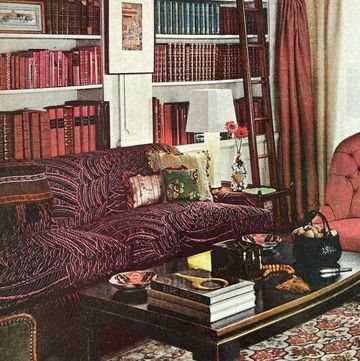
These were interiors that everyone wanted to see, but characteristically, their owner would not permit them to be published. Jackie Kennedy might have led the nation on a televised tour of the White House, but her later New York home was off-limits to photographers. Only once did she give a tantalizing glimpse of her library and dining room, allowing two pictures to run in House Beautiful in 1971 to promote the fabrics of the Design Works of Bedford Stuyvesant, an African-American enterprise in Brooklyn.
That ability to control publicity, which she had to surrender every time she left her front door, extended to the vacation house she built on a breathtaking 356-acre site on Martha's Vineyard in the early 1980s. "The most important thing to Jackie was her privacy and her role as a mother to those children. That's what this house gave her," says the architect Hugh Newell Jacobsen, who designed the traditional saltbox overlooking the Atlantic but was sworn to secrecy about the commission.
During the White House years, Mrs. Kennedy herself designed Wexford, a contractor-built, one-story getaway house on Rattlesnake Mountain in Atoka, Virginia, which she and the President occupied for only four weekends before his death. She was actively involved in working out her Vineyard house with Jacobsen.
After receiving the architect's plans, Mrs. Onassis traced them on the beach at Hyannis Port to understand the size and progression of spaces. As Jacobsen reminisces, "She called me and said, 'Give me an idea of how high the ceiling is in the living room.' And I said, 'It's eleven feet.' She said, 'What's eleven feet?' And I said, 'The big living room in Rose Kennedy's house.' Then she asked, 'What's eight feet?' and I answered, 'The guest bedroom you put me in the last time.' She said, 'That's fine. I can feel that now.'"

Averse as she was to publicity, the idea that Jacqueline Kennedy Onassis never spoke to journalists is mistaken. In 1980, I was writing a New York Times Magazine article on the changes made to the State Rooms at the White House after her restoration, and she agreed to cooperate. "Ever since Jack died," she began our first conversation, "I've tried to keep my name out of the press. I'll do everything I can to help you with your piece. But you will protect me, won't you?"
Over the next few weeks, she called many times with names and telephone numbers of people she thought I should speak with and contacted several of them for me. When one photo of the Green Room proved impossible to find elsewhere, she had her old friend and spokeswoman, Nancy Tuckerman, take me to the warehouse on Manhattan's West Side where Mrs. Onassis kept her White House files and memorabilia. In that jam-packed storage room, on top of a huge pile of furniture and cartons, lay one of JFK's rocking chairs, upside down. Like the last scene of Citizen Kane, it was a wrenching reminder that our lives are more evanescent than our possessions.
Jacqueline Bouvier Kennedy Onassis fought against time by keeping her own surroundings as unchanging as possible. Though she never said so publicly, she told me she disliked having her White House interiors undone after only a decade by Clement Conger, the strong-willed curator appointed by Richard Nixon in 1970. Kennedy partisans feel that Conger and his decorative arts consultant, Edward Vason Jones, made the State Rooms showy, cluttered, and inconsistent.
I assured her that I preferred her conception of the White House to theirs. "You're not going to tell him your angle, are you?" she asked about my impending interview with Conger in Washington. She giggled with conspiratorial glee and said, "I can just see you down there in your little seersucker suit, looking so innocent and all."
The last time I spoke with her about her restoration, she said philosophically, "You know, in another hundred years it will be just one more chapter in the history of the White House." She was wrong. With her brilliant sense of history, she must have known that her chapter in the annals of the arts would be a very important one indeed.