6 min read
Chances are, your alarm clock is not the most luxurious part of your home. It’s easy to go with the first budget clock that doesn’t look hideous. Or maybe you resign yourself to jarring phone alarms that sound like emergency sirens. As a design editor, I'm here to make a case for a bigger investment in your sleep: luxury alarm clocks.
The sleek gadgets are taking over, from residential design and gift-giving spaces to hospitality. Anyone obsessed with getting the best night's rest has likely seen the Hatch Restore alarm clock all over their feeds. Meanwhile, the Longfellow Hotel in Portland, Maine, puts the Loftie, another luxe alarm clock, in every single room, providing calming meditations and sound baths for guests.
These alarm clocks have refined designs that don't stick out as an eyesore on your nightstand, and they go a step beyond just playing noise to wake you up in the morning. They may have different aesthetics, tech features, and price points, but they all share one mission: keeping the phone out of your bedtime routine.
To see if this growing trend was worth the hype (and the money), I decided to test three of these clocks: the Loftie, the Hatch Restore 3, and the Nanu Arc. Here's what I found, after over a year of having them in my home.
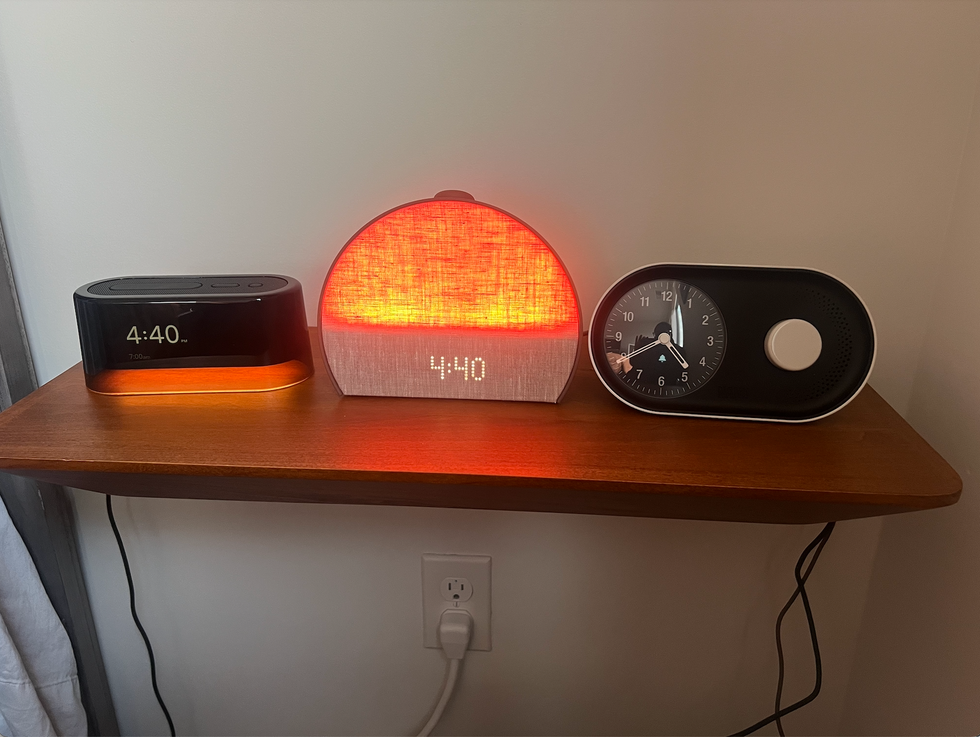
How I Tested Luxury Alarm Clocks
I’ve had these three clocks for over a year. For my evaluation, I focused on how each alarm clock impacted my sleep routine. I wanted something that would wake me up peacefully, but effectively. As for bedtime, I tested how well the clocks lived up to their phone-free promises. As an insomniac and professional doom-scroller, this was the most important piece. I also paid attention to the visual design and aesthetic, though this is definitely the most subjective factor.
Hatch Restore 3
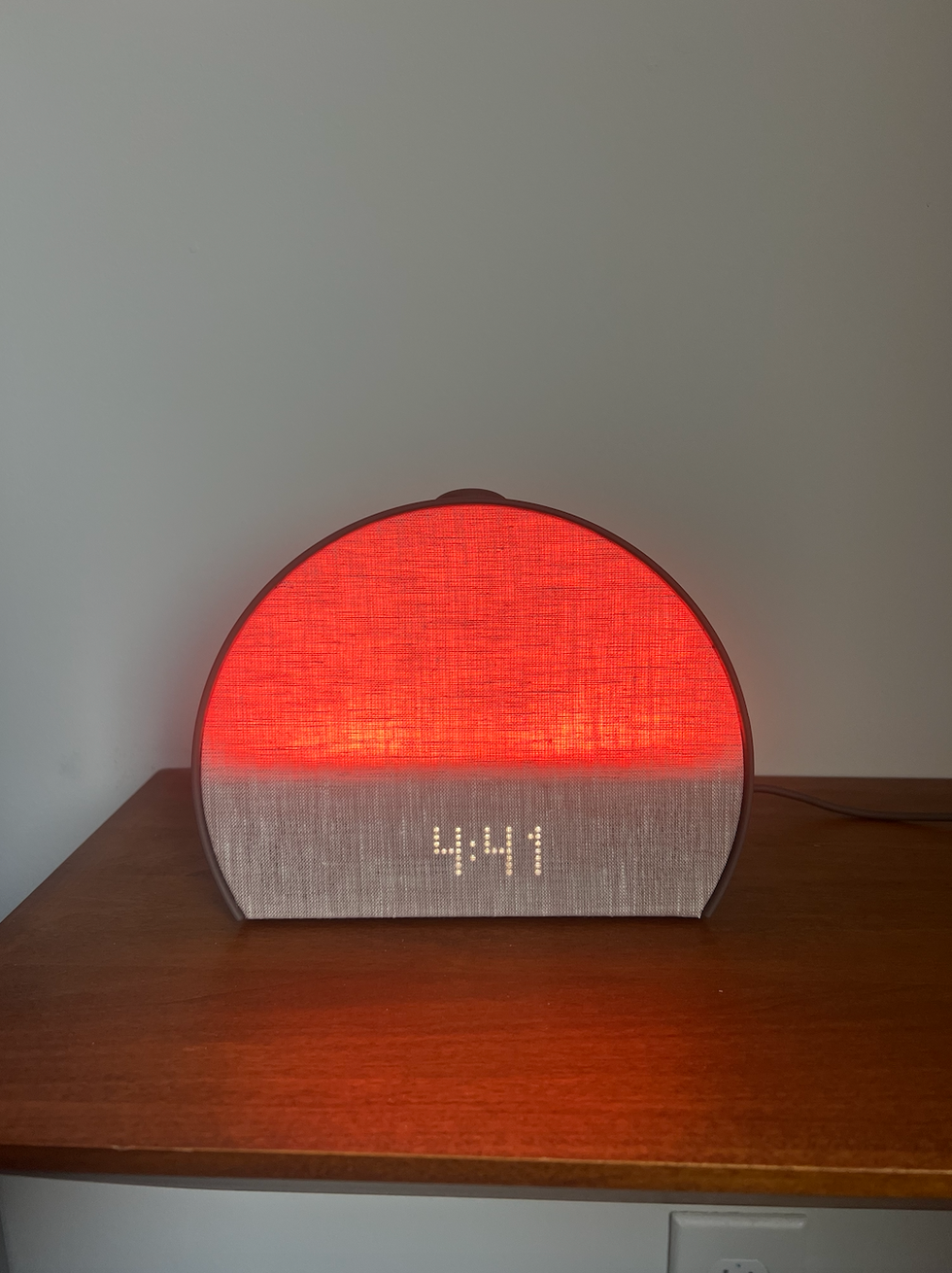
The Hatch Restore clock is probably the most viral of the luxury alarm clocks I tested. It is certainly versatile: it’s part sound machine, part alarm clock, part color lamp. The neutral, fabric-covered design makes it one of the most stylish to leave out on your nightstand. Hatch recently released the Restore 3, which is the model I tested. This model has updated phone-free features, namely a large button on top to switch between routines, meditations, and brightness settings.
The Restore 3 focuses on a holistic approach to your sleep, aiming to help you build a more restful routine vs. just waking you up on time. The clock pairs with the Hatch app, where you can enter details about your habits to get extra tailored settings. The first thing I did was fill out a personalized quiz to find my sleep personality (The Moon’s Companion: fitting for my insomnia). It then suggested a routine: a sequence of sounds, light settings, and meditations, laid out to walk me through a restful night’s sleep. It felt like a sleep concierge at the ready on my nightstand.
One of the most desirable features of the Hatch clock is its sunrise functionality. It slowly increases its brightness to a color of your choice. So if you don’t have the sun beaming through your window in the morning, this can mimic that sunny feeling.
I will note that, since you have to set the routines in the app first and switch between different colors and sounds, this clock requires the most interaction with your phone. It’s worth it, though, because the app’s offerings are so calming, and it moves through routines seamlessly. Once you create the ones that work for you, you can toggle between them without touching your phone. But it’s not an app you could delete while you have the clock. Additionally, you will need to pay a subscription fee ($49.99/year) to access all sleep sounds, meditations, and wake-up content if you want more than the basics.

Pros
- Available in three neutral colors with a soft fabric face
- Doubles as a sunrise lamp that adds diffused, colored light to your bedroom
- Button on top toggles through routines easily
- Unique half-moon shape
- Variety of soundscapes, music, sleep stories, and meditations

Cons
- Requires phone interaction to set or change the routines
- Subscription needed to access many of the sounds and meditations

Nanu Arc Alarm Clock
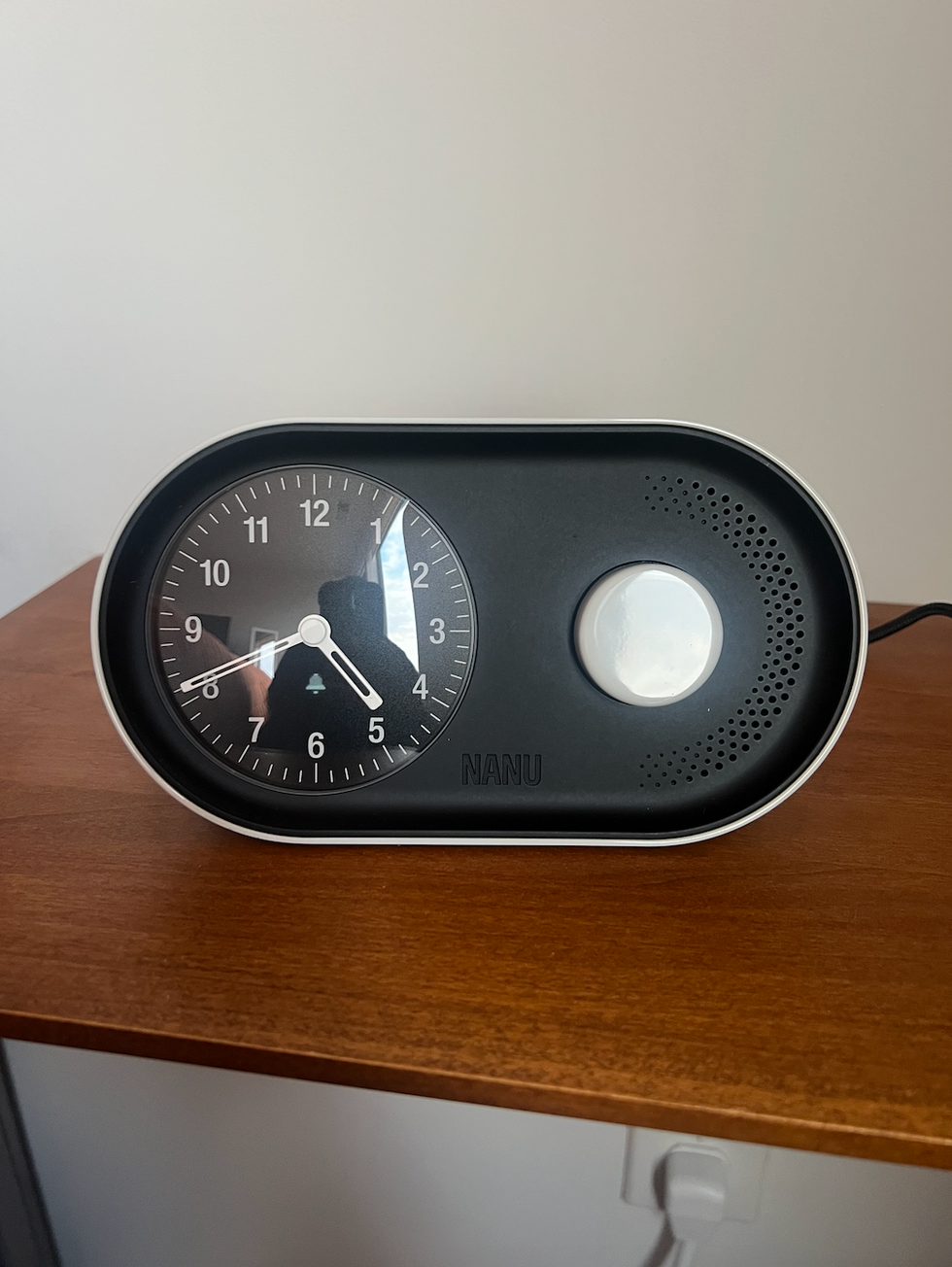
The Nanu Arc alarm clock comes with the fewest bells and whistles of the three I tested—but that’s kind of the whole point. This one felt the most effective at removing your phone from your bedtime routine. The clock is completely manual. It’s a clock, not a smart device meant to bio-hack. There’s no app needed to use it, just a snooze button on top, an alarm button on the front, and two knobs on the back for time and brightness adjustment. The analog display is super easy to read, and there’s something nostalgic about a well-made clock designed to last. The display dims really well, so if light in your bedroom tends to keep you up, this is the ideal find.
The clock's look is a minimalist’s dream. It has a smooth, sturdy metal body and a more retro feel, but it’s still sleek enough not to look out of place on your nightstand. Because this is the simplest alarm clock, there isn’t much customization. You can only set one alarm at a time, and there’s only one built-in tone.
Let me say, though, that tone is SO pleasant. It’s a soft chime like a singing bowl, and it felt like gently waking up in a mountain monastery. It’s such a pleasant departure from the sirens I usually wake up to on my phone. It also gradually increases in volume, so it’s still able to rouse me awake. It’s a soft welcome to the day. Ultimately, I need to be able to set different alarms for different days, so this isn’t my perfect fit, but still a great option for people.


Pros
- Soothing chime wakes you gently
- Analog clock hands move silently
- Completely phone-free
- Heavy metal body will last you years and can be repaired
- Luxury tactile feel with rounded buttons
Cons
- Only one alarm setting and tone
- At set-up, you need to pay extra attention to instructions
Loftie Clock
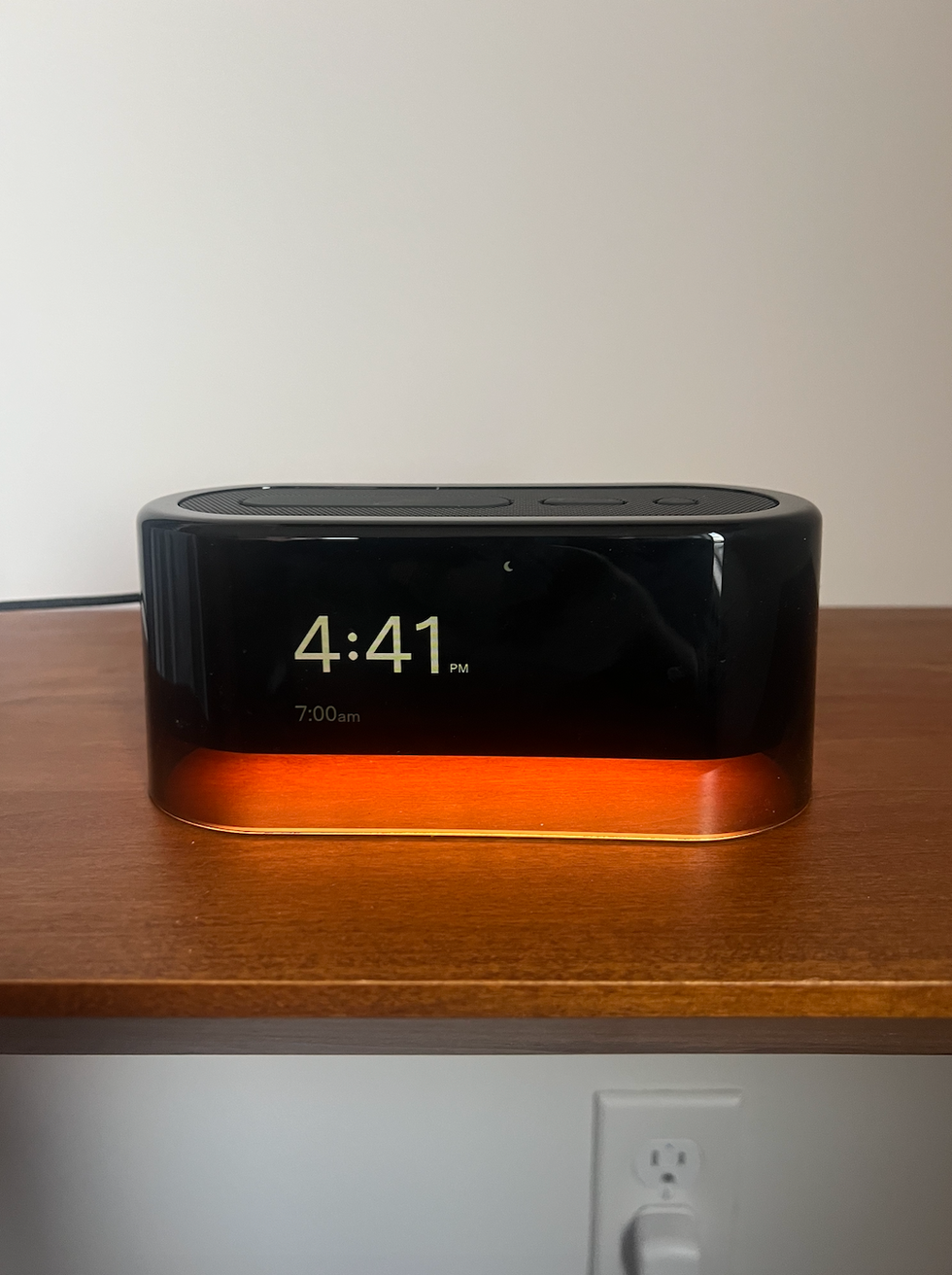
The Loftie takes on more of the traditional hotel alarm clock aesthetic, but it still comes with amazing features. The clock uses a two-phase alarm. The first is a wake-up alarm that rings for about 30 to 40 seconds, gently rousing your brain from sleep. Afterwards, the Loftie will snooze itself for nine minutes (or shorter, if you choose). Then the get-up alarm will sound, and that’s intended to get you up on your feet. Turns out, this system is so helpful. It keeps me from setting a dozen alarms on my phone all one minute apart (a habit that did NOT make me a fun roommate).
There is a Loftie app you can use to change settings, but the clock keeps its promise: you need the app for setup, but after that, you don’t have to touch it. In over a year of use, I haven’t touched the Loftie app. Every sound, volume level, brightness setting, and alarm can be controlled using the buttons on the clock itself.
The Loftie also comes with a soft nightlight that shines through the glass shell, and it looks so cute. I think I would enjoy it better if it were on a see-through table, though. Some of the light is dampened on an opaque surface, so I found a slightly translucent tray to rest it on.
The Loftie is full of calming sounds and tones that make my Gemini heart very happy. I can switch up with ease when one tone stops working for me, no app needed. My favorite feature, though, is definitely the bed signal. At a time of your choosing, the Loftie will play a soft tune for about three minutes and light up, signaling that it’s time to wind down and go to bed. Of all the features I tested, this was the most effective. Hearing it snaps me out of an endless TikTok scroll and genuinely helps my brain move to a calmer place.

Pros
- Phase system wakes me gently, without needing to set back-to-back alarms
- Intuitive button controls and digital clock face
- All controls are within the clock itself
- Can set multiple alarms at once
- Bed signal genuinely helps me wind down at night
Cons
- No “sunrise” function
- Bluetooth speaker is a bit crackly
The Final Verdict: Which Clock Is My Favorite?

Though I loved my experience with each clock, I don’t need three clocks ringing simultaneously to wake me up in the morning. For the last year, I’ve been waking up to the Loftie every day. Every single setting can be accessed and adjusted directly on the clock, so it truly keeps my phone out of the bedroom. Its bed signal helped me build a wind-down habit, and it’s still super customizable.
There’s a clock for every kind of sleeper, though. If you’re dead set on having no phone involved and have a pretty steady weekly routine, the Arc is perfect for you. One alarm, low brightness, easy to read, and easy to wake up to. If you want to prioritize aesthetics, slowly lulling yourself to sleep and waking up like you’re a Disney princess, I’d definitely go with the Hatch Restore 3. It’s honestly so pleasing to look at and interact with, and it works as a beautiful color lamp even without alarms being set. Just be prepared to exercise a touch more restraint with your phone, as you’ll have to use it more than the Arc or Loftie requires.