Every home can benefit from a kitchen island, even if space is at a premium. Before you set out to design and install one, the experts share their top tips and what to consider.
Why is a kitchen island a must-have?
A kitchen island is a freestanding countertop unit in the middle of a kitchen, serving as a focal point to prepare food and eat meals. One of the most sought-after features, kitchen islands are accessible from all sides, adding more precious space and storage.
'Islands tend to become a home theatre of cooking. They put the cook at the heart of the layout – front, and centre stage,' says Graeme Smith, head of retail and design at Life Kitchens. 'They also act as a natural room divide, bridging the kitchen to another space, be it a dining or living environment. Add in storage below for utensils in drawers, an integrated bin for food scraps and a chopping block for a designated prep area.'
So how do you design a kitchen island?
Think about its purpose. Will it be a space for cooking or are you dreaming of creating a communal spot for relaxed dining? Once you have decided on the main use of your kitchen island, it's time to choose the size. If you're working with a more compact space or a galley kitchen, it might be best to consider narrow, freestanding styles. If you're blessed with a large kitchen, consider building in bar stools for dining.
'Assuming the size of the room allows for an island, one of the most important things to consider is how you would like the island to look and its functionality,' says Richard Davonport, Davonport managing director and founder. 'Functionality and style go hand in hand, as the functionality that is required from an island will inevitably influence the design. For example, is seating required, and if so, for how many people? This would ultimately impact whether a breakfast bar was included or whether banquette seating would be a better option.'
What size should a kitchen island be?
According to Life Kitchens, the desired amount of room is approximately 1200mm between fitted cabinetry and the island, although extra floor space may be needed in areas that experience a lot of high traffic (such as around the hob).
Designers at Harvey Jones advise that kitchen islands need to be at least 1000mm wide in order to be safe and practical. While many people think bigger islands are better, this isn't always the case. 'Wide islands are sure to make a big impact in a kitchen, however, they're not the most practical solution, as you have to be able to reach the middle when cooking,' they advise. 'Try to keep it no deeper than 1400mm front to back.'
What's the difference between a breakfast bar and an island?
Breakfast bars are typically incorporated within kitchen islands or peninsula-style layouts to create a laidback, informal space. While they both add counter space, a breakfast bar is attached to either an existing counter or wall, featuring only three usable sides, and is typically higher than kitchen counters. Breakfast bars are great to consider if you have a smaller kitchen, as they don't take up as much room.
So is a kitchen island a good idea?
Adding a kitchen island immediately creates more seating for friends and family, as well as additional counter space and storage. You need to consider the cost (materials can be expensive), space in tight kitchens, and appliance placement (some kitchen islands require special wiring and plumbing). Speaking to a professional kitchen fitter will help you understand whether a kitchen island is a good idea in your home.
Need inspiration? Take a look at some of our favourite kitchen island ideas...
1
Decide on the purpose
Olive and Barr
When designing your kitchen island, think about how you'd like to use it daily – whether you want extra space to serve food, an area for family and friends to dine, or a spot for children to complete homework.
Think about the worktop, the storage and whether you want to use it as your main workspace. If you have a smaller run of cabinetry, you may want to move the hob onto the island to allow for more surface area.
Exposed wood kitchen islands are guaranteed to make a statement, even in the most pared-back kitchen.
Claire Garner, director at Claire Garner Interiors, says it's ideal for creating traditional rustic charm. 'Wood plays a pivotal role, whether it’s used for cabinetry, shelving, or kitchen accessories as its rich textures and warm tones infuse the space with a sense of history and authenticity,' she explains.
Advertisement - Continue Reading Below
3
Go for multifunctionality
David Woolley
Combining style and practicality, this slate grey kitchen island has it all: cupboards for additional storage, breakfast bar seating and a large work surface ready for fruit bowls, flowers and platters, perfect for entertaining.
4
Colourful accents
Wood Works Brighton
A kitchen island offers the opportunity to get playful with design, as is the case with this wooden island with a glossy terrazzo worktop. Bright yellow light fixtures give this light and airy space a pop of zesty colour.
A common instinct with kitchen islands is to match them to the rest of the kitchen cabinetry, and whilst that can work wonderfully, the island is a natural standout feature and can be treated as such.
6
Blue sky appeal
Hush Kitchens
Need some colour inspo? A soft sky blue hue will bring a lightness to what is predominantly a functional space. This sleek example is from Hush Kitchens' Lugn range, with doors colour-matched to Farrow & Ball’s Dix Blue.
Yes, you can add vases, bowls, hobs and sinks on top of a kitchen island, but a plain kitchen island devoid of clutter looks sleek and will delight minimalists. Chairs crafted from natural materials and plants complement the pared-back style of this kitchen.
Using a butcher block as a makeshift kitchen island is one of the best solutions for smaller kitchens. You can buy really wonderful vintage and reclaimed versions, and they are exceptionally sturdy and hardwearing for even the most demanding family kitchens.
Advertisement - Continue Reading Below
9
Pink on pink
Herringbone
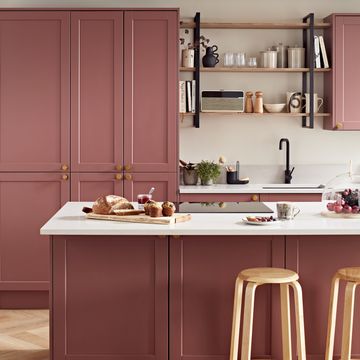
Stick to a tight colour palette but experiment with varying shades, just like this delightful pink kitchen. The narrow kitchen island adds warmth to an already luxe room scheme.
'Make sure the island is in proportion with the rest of the kitchen,' says William Durrant, owner of Herringbone Kitchens. 'Dependent on the sizing of the room and the gapping around the island, you'll need to have a minimum 900-1000mm walking space. It needs to be more if you have seating around the island and if you have appliances. Try to increase the space to 1100-1200mm.'
Green kitchens are always a good idea (and, most importantly, it's a timeless choice). Associated with nature, it's a shade that is both sophisticated and refreshing, creating a peaceful and relaxed environment for the home.
Handmade using natural pigments, these encaustic tiles come in three dynamic colourways and can be laid in a number of different patterns for an individual look with lots of texture and character. It looks fabulous on this kitchen island and is repeated as a splashback for continuity.
If your kitchen is as dark as this one, the inclination might be to use a darker, richer stone on the kitchen island. The bright contrast of a white marble is a welcome one, and pulls focus to the centre of the room where all the cooking action is happening.
Advertisement - Continue Reading Below
13
Ensure it's functional (and makes you smile)
Carolyn Barber / House Beautiful
A happy, uplifting shade, yellow is a brilliant choice for the kitchen. Used as an accent here, the sunshine shade adorns cabinet drawers on the island and pendant lights hanging above, contrasting with the crisp white wall.
14
Leave enough space for food prep
Life Kitchens
We love the wooden block on the end of this island, providing the ideal surface for chopping fruit and veg. It's a good way to subtly zone an island. This island might be compact but it's been cleverly designed to fit in a bar stool, too.
If you're dreaming of a kitchen island, consider making space for a kitchen sink. Corralling your food preparation and washing up functions onto the same space makes for a much more functional layout.
16
Make it luxe industrial
Caesarstone/BIRGIT MONS
With a cool urban vibe and no-nonsense practical qualities, industrial finishes remain firm favourites in our homes, and Caesarstone is ticking all the boxes with its 4023 Topus Concrete, a hardwearing, non-porous, scratch- and stain-resistant quartz. A big selling point is that it comes in a lovely soft neutral greige with pinky undertones that would add a warm, luxe feel in a kitchen. It looks super-elegant on this kitchen island, shaped into a curved top and teamed with pretty mint green paintwork.
How do you nail the quiet luxury look in a kitchen? 'Within the home, we translate this term to focus on the quality of materials selected and allowing them to dominate the style of the room,' says Melissa Klink, creative director at Harvey Jones. 'The blend of unique finishes creates spaces that are immediately elegant and softer as a result of the layered combination. Think thicker worktop slabs with specialised edge detailing instead of obvious bold and colourful veins of marble.'
You can also use additional colour to give your space more dimension. 'This doesn't need to be a new colour as a different tone of the main run of cabinets works well too,' says William. 'You can always bring in a pop of colour or a darker tone such as a deep purple and paint your cabinetry in a lighter colour.'
Want to maximise space? Make your cooking area the centre of the kitchen by installing a hob and extractor fan within your kitchen island. Not only will it allow you to be more sociable as you cook, but it will save on vital surface space, too.
20
Go gold
Dunelm
Want to create a style statement? The application of gold leaf on this kitchen island, along with gold and brass accessories, creates wow factor.
'Including an island or breakfast bar in the kitchen design helps to create a partition between kitchen and living space. This will help define areas of the room without closing in the kitchen or blocking off the rest of the room,' says Naomi Dean, furniture and showroom designer at Harvey Jones.