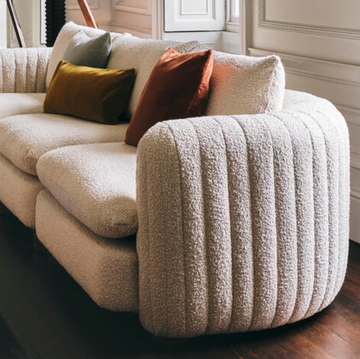
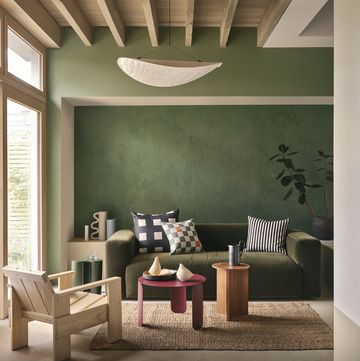
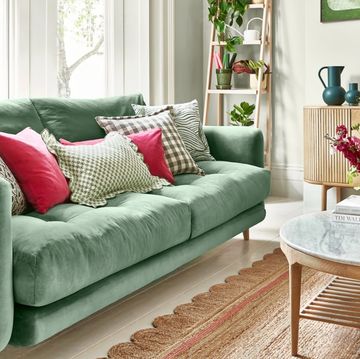
For decades, one sofa rule dominated British living rooms: buy the three-piece suite. One main sofa, two matching chairs, everything coordinated and neatly arranged.
According to Lucy Mather, interiors expert at Arighi Bianchi, British living rooms are shifting away from rigid sofa ‘rules’ and towards seating that’s flexible, layered and built around real life rather than showroom symmetry.
‘Rather than shopping for a sofa, more people are approaching seating as a design plan, not just something we pick to fit in a room. It’s less about finding the perfect finished piece and more about creating something that suits how they actually live – right now,’ Lucy explains.
In fact, she says five other classic sofa 'rules' no longer apply either.
1. Stop matching everything
Matching sofa sets once signalled a finished, well-put-together room. Today, they can feel flat and overly coordinated.
Mixed seating — different fabrics, depths or even styles — feels more relaxed and personal. A practical everyday piece can sit alongside something more indulgent without the room feeling disjointed.
'Pouffes, side tables, moveable pieces and even the absence of a traditional coffee table all point to a looser, more layered approach,' she says.


2. One sofa isn’t enough
The era of the single big purchase is fading. Instead, many households are building seating gradually; a compact sofa now, a chaise later, or a modular corner that can be separated into individual seats if the room changes.
‘The biggest shift is from statement piece to a seating system approach,’ Lucy explains. ‘Sofas are no longer treated as untouchable centrepieces; they’re being broken down into components. A two-seater added to later. A chaise swapped from left to right. An extra section introduced when space allows or removed when it doesn’t.’


3. Your sofa doesn’t need to face the TV
With laptops, tablets and phones competing for attention, the television is no longer the sole focal point.
Sofas are being angled, floated away from walls or arranged to face each other instead. Conversation and flexibility are increasingly driving layouts.
‘This move towards self-configuration and away from the three-piece suite era reflects a broader change in how modern homes function,’ Lucy adds. ‘Living rooms now double as workspaces, social hubs, family zones and places to properly switch off. One rigid seating arrangement simply doesn’t work for all of that.’


4. Corner sofas aren’t just for big rooms
Once considered bulky and space-hungry, modern corner sofas are slimmer, more adaptable and with a lower profile.
In smaller homes, they’re often used deliberately to define zones — particularly in open-plan layouts — rather than dominate the room. Lower-profile seating also allows more daylight to flow, especially in spaces with large windows.


5. Pull your sofa away from the wall
Increasingly, sofas are being used as room dividers in open-plan living, and now there’s intentional imbalance – offset rugs, one chair, mixed shapes and multiple coffee tables versus one table placed in the middle.


‘Flexibility is trumping formality,’ says Lucy. ‘People want seating that adapts to them, not the other way round.’
This shift, she adds, isn’t about rebellion. ‘It’s a practical response to how homes – and lives – have changed. People are moving more frequently, staying in rented homes for longer and asking more of the same space.’
Above all, configurability offers reassurance. ‘If a room changes, the seating can change with it. If a household grows, seating can expand. If priorities shift, layouts can be reworked without starting from scratch.’
It’s also why there’s less pressure for sofas to look ‘perfect’ from day one. ‘Lived-in, evolving spaces feel more honest than show-home symmetry,' she adds.
Follow House Beautiful on Instagram, TikTok and Pinterest